
DIGITAL DESIGN FOR PATIENT-CENTERED CARE
Medicine Literacy Platform
Client: SageScript
Location: Delhi and Jaipur, India
Challenge
India's healthcare users face persistent barriers to safe medicine use. More than half self-medicate, often without knowing a drug's interactions, side effects, or correct use, while prescription-only medicines like antibiotics and painkillers are sold over the counter without pharmacist guidance. Many patients cannot parse the jargon on a prescription, which leads to wrong doses and incomplete courses. Generic prescribing stays extremely low despite regulations that encourage it since patients rarely know that safe, cheaper equivalents exist or how to ask for them at pharmacies that push for branded drug use. Overprescription is routine. Patients are put on several drugs where one or two would do, on expensive new agents where a generic would work, and on prescriptions that are never clearly explained. Those patterns compound into adverse drug reactions, prescription fatigue, out-of-pocket strain, and a growing powerlessness in one's own care.
The project was focused on helping patients in urban India make sense of their prescriptions, question medicines they did not need, and discuss safer and more affordable alternatives with their providers.
Work
This product is the successor to Catapult's earlier research project with the client, The Dilemma for the Indian Patient, which mapped how people self-manage chronic conditions when doctor-patient communication breaks down and sharpened the questions this project set out to act on. Building on that, the team worked with patients, caregivers, and providers, alongside the client and health-content experts, refining each direction with their input across three phases.
ALIGN PHASE
Framing the problem and the users
With medicine literacy as the goal, the team defined three target segments to focus on: urban and semi-urban adults with recurring acute issues who lean on chemist advice rather than doctor visits; urban middle-income chronic patients, such as newly diagnosed diabetics, juggling modern and alternative providers; and caregivers managing the medicines of elderly parents or children. Desk research mapped how each moves through acute and chronic medicine journeys.
Deliverables: desk research and journey maps; defined target segments; MLP (Minimally Lovable Product) definition.
ENGAGE PHASE
Learning from patients and providers
Across Delhi and Jaipur, the team ran in-depth interviews with users aged 12 to 65, eight focus groups with 20 participants, and interviews with five healthcare providers. Those insights became interactive Figma prototypes, including a medicine decoder, a tracker, and cost-comparison tools, alongside an AI-powered WhatsApp assistant, refined through rounds of user feedback.
Deliverables: user and provider research; refined MLP profile, interactive prototypes.
SHARE PHASE
Turning insights into product definition
Working from the testing, the team refined a value-proposition framework and a full product definition with the client, ranking features separately by the people who would use them and the doctors who would see the results. Each feature was paired with success metrics, the reasons to believe it would hold up in real use. The definition also set a build order, starting with the core needs of records management and medicine-decoding features before adherence support.
Deliverables: Product Definition Document; value-proposition framework; prototype testing readout.
Outcomes
Testing reframed who the app was really for. Across the segments, the primary archetype that surfaced was the Distributed Caregiver, usually between 25 and 45, the person who becomes the household health anchor and works out medicines just in time for whoever needs help. The acute self-medicators and chronic patients remained as archetypes, but their needs kept converging on the caregiver managing care for others as much as for themselves. The highest-value unmet need was not education but a shared, searchable health record that travels with the user across doctors and emergencies. No existing tool served it, so people improvised with WhatsApp photos, ChatGPT, and paper files that get lost.
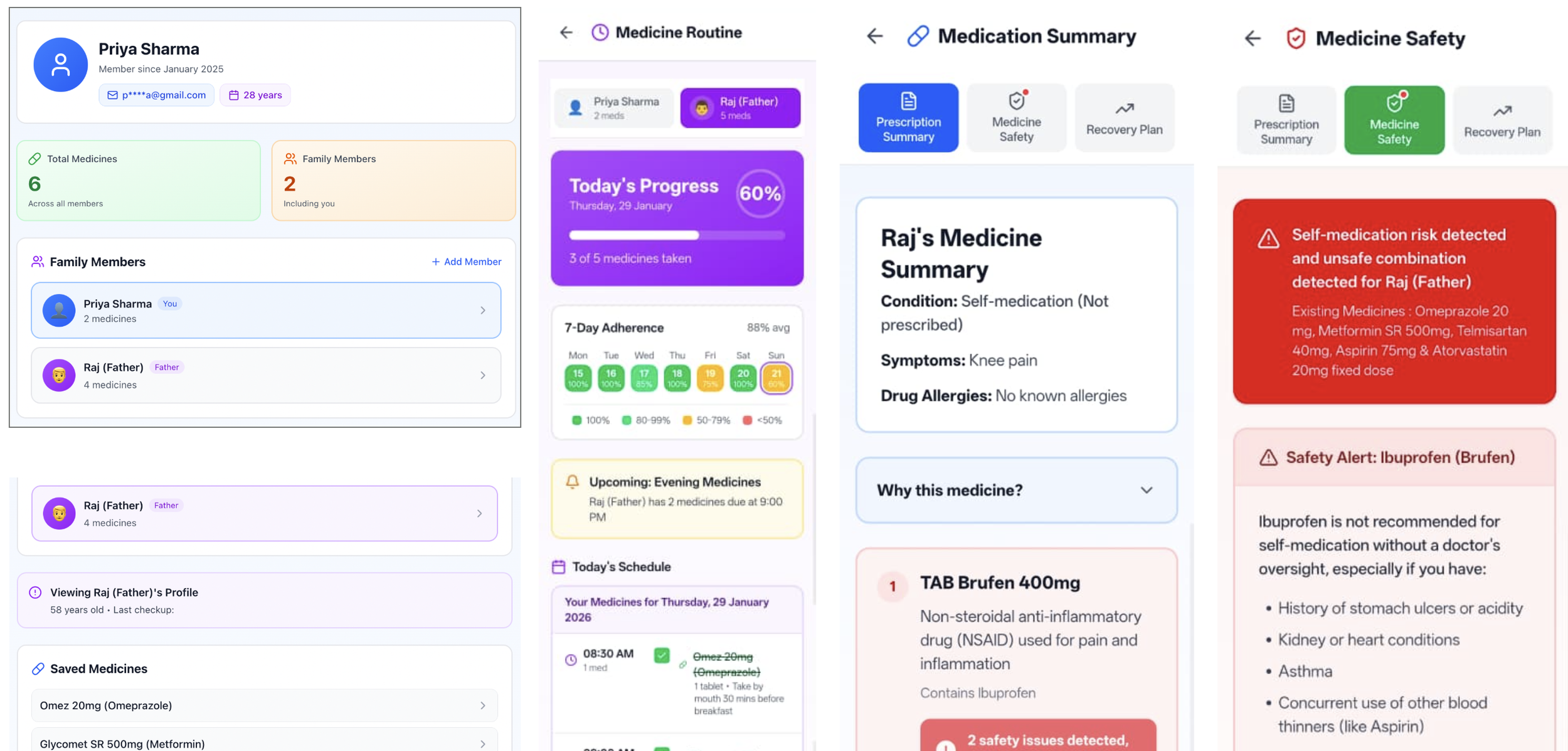
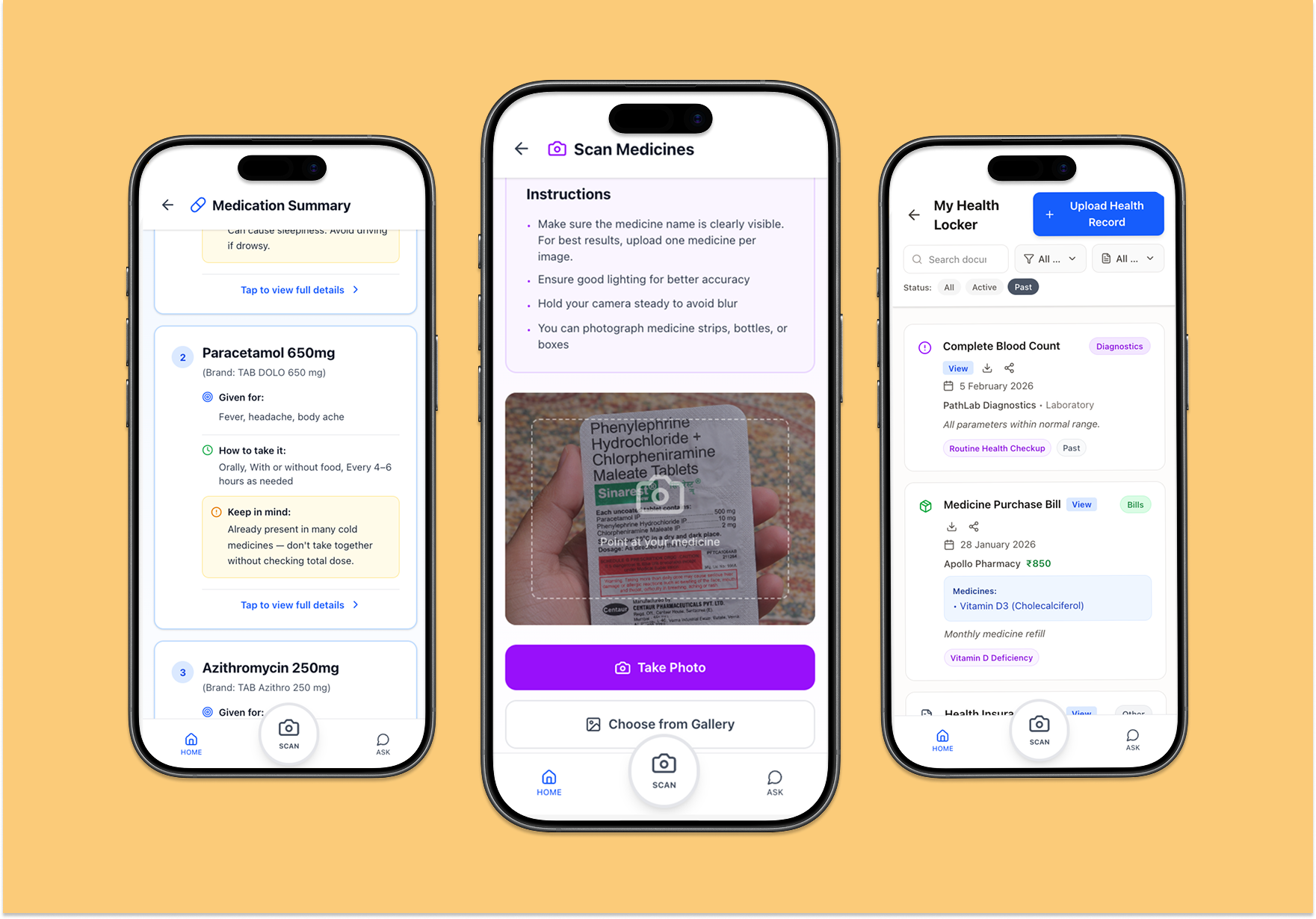
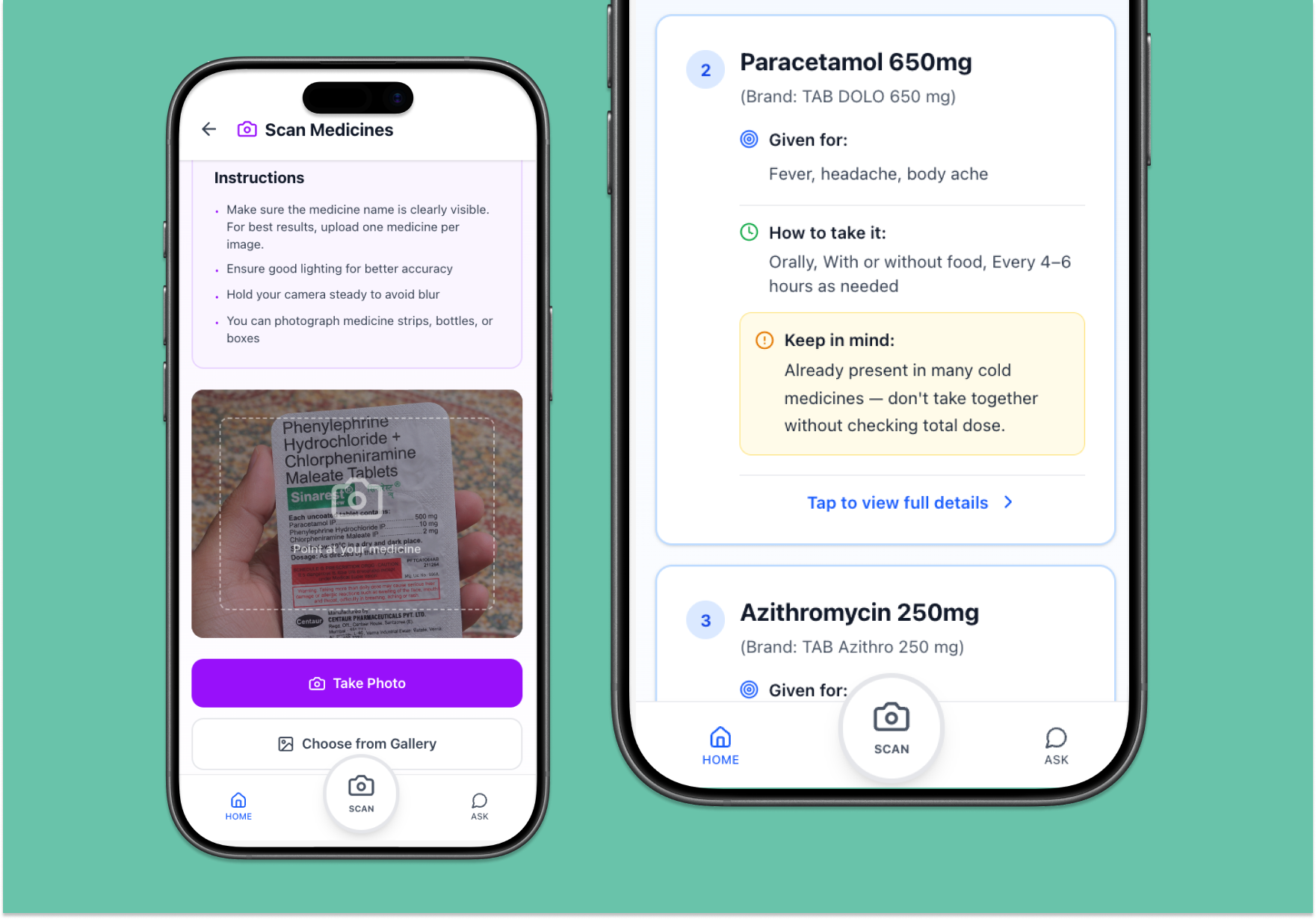
Those findings shaped the app, a reliable health memory and medicine translator that helps people store, understand, and act on their medical information without confusion, loss, or guesswork. A Health Locker turns scattered prescriptions and tests into a structured, searchable archive that is built for shared caregiving and held privacy-first as a public good. A Medicine Decoder lets a user scan a medicine and understand it in plain, non-alarmist language, generics included. The engagement delivered that product definition, ready for the client to take forward.
Looking Forward
The prototype phase is complete. Next, the product will be built and moved into piloting, where it will be tested and refined with the patients and caregivers it is designed for before it scales.