
FRAMEWORK FOR DECOLONIZING DESIGN
Indigenizing Design
Funder: National Endowment for the Arts
Location: Phoenix, Arizona, United States
Partners: CahokiaPHX, Indigenous Community Collaborative, Brian Skeet Design LLC
Challenge
Human-centered design promises that the people closest to a problem shape its solution. In practice, the process still routes decisions through the designer. Communities are consulted, designers interpret, and the same gatekeepers decide. The method widens the input funnel without moving the authority — and when it is applied to Indigenous communities, it arrives carrying Western assumptions about what counts as knowledge, who is qualified to produce it, and what design is for. Indigenous design gets read as heritage rather than as practice, and practitioners are asked to leave the part of themselves that does the work at the door.
Between 2021 and 2023, Catapult Design worked with CahokiaPHX — an Indigenous-led social tech and artspace in downtown Phoenix — alongside Indigenous Community Collaborative and Brian Skeet Design LLC, to define that language. The work was funded by a National Endowment for the Arts Design Grant. The goal was not to build a better design process for Indigenous communities. It was to support an Indigenous community in naming a process it already had, in terms it set itself, and in a form that could be taught.
Work
This was a community-led project, and the collaboration model was the first thing designed. Catapult Design's team was explicitly external to the Indigenous community, and named that position out loud rather than working around it. CahokiaPHX led the process, facilitated its own community, and held final decision rights over language and content. Catapult built structures, scoped methods, framed activities, and supported as the amplifier rather than the primary do-er. That single shift is what made the rest of the findings possible.
Two more mindsets governed the work. Consensus-driven decision making, a governance style valued in Indigenous knowledge, was interwoven through scoping, facilitation, and synthesis: it does not require that everyone agree on one answer, but that every perspective is heard and carried into the decision. And pace was set by the community rather than by the project plan. Design's habitual speed is a form of control, so slowing down the process gave the framing of the problem back to the people who live inside it.
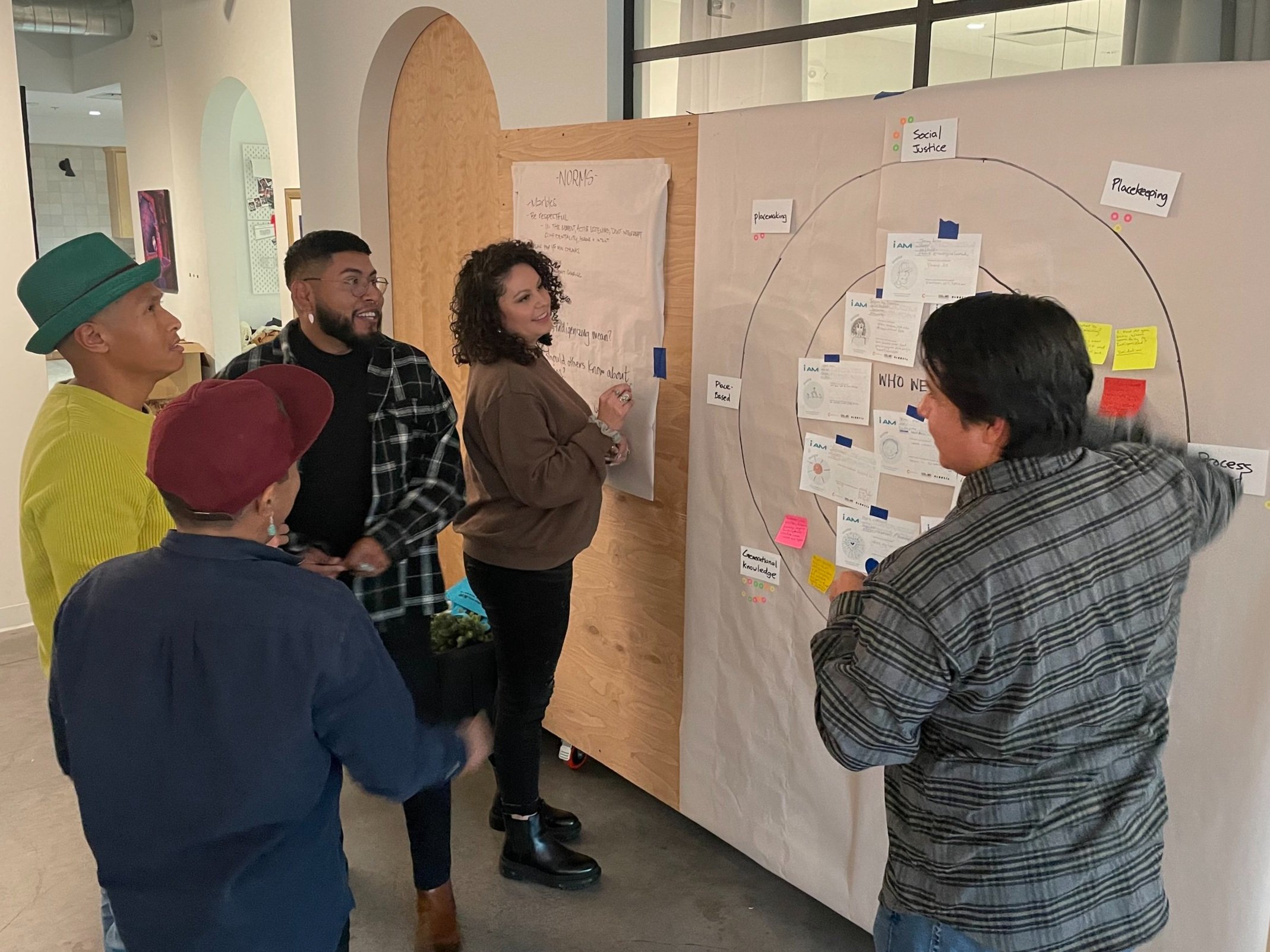
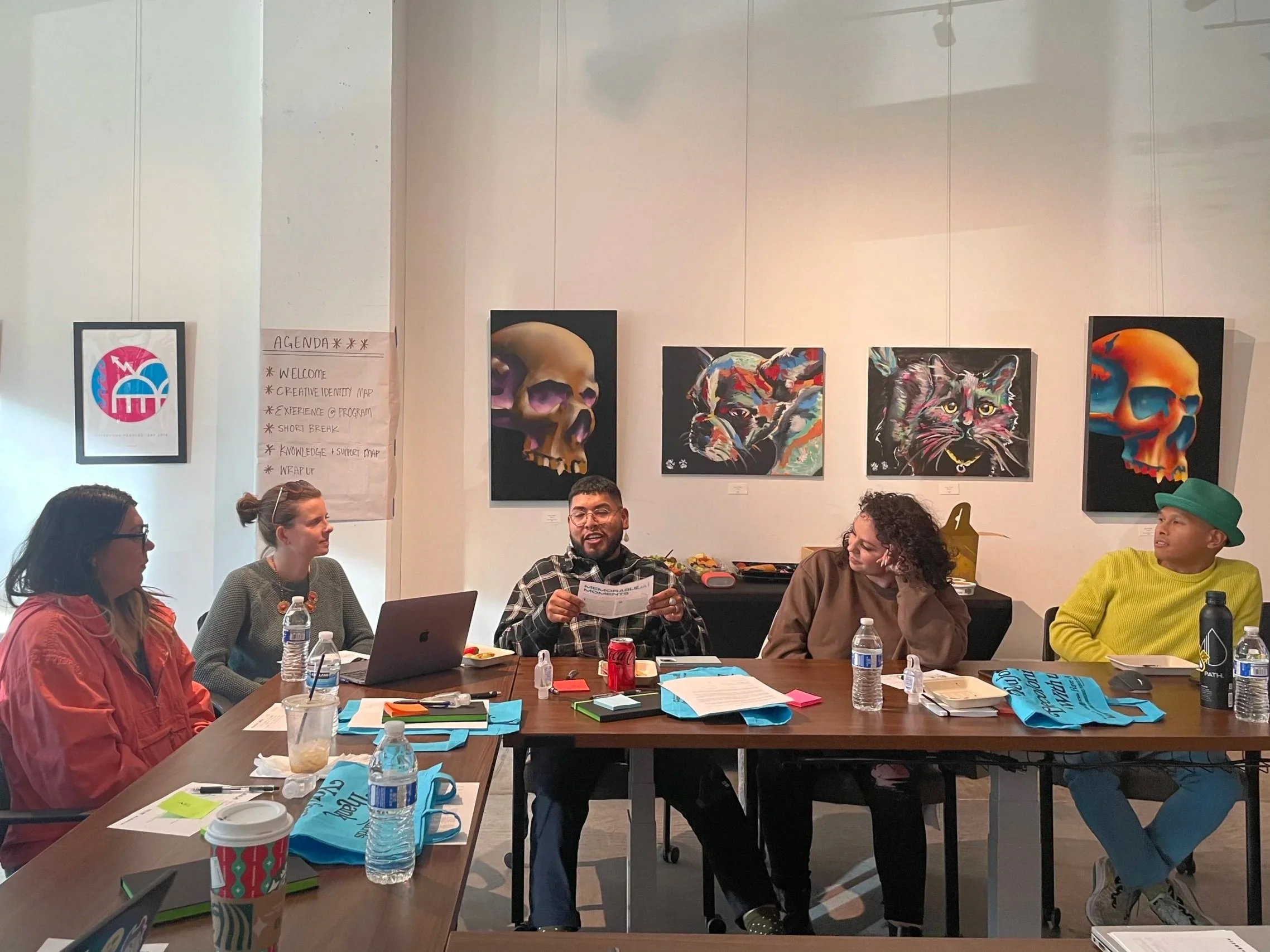
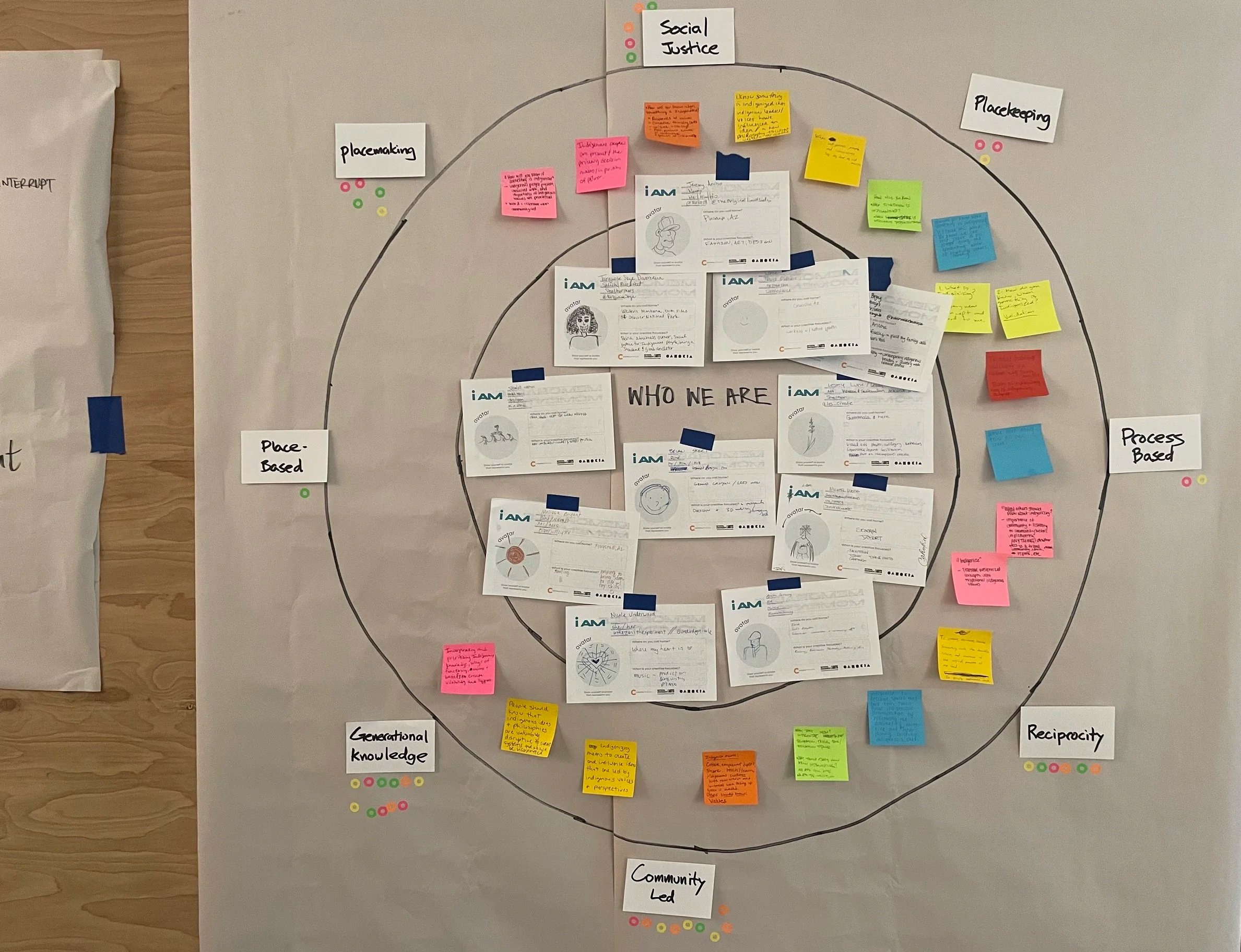
Over roughly a year, the project team engaged more than 90 Indigenous creatives and social entrepreneurs from urban and reservation-based communities, representing 11 Tribal Nations, across three engagements. The team worked in focus groups rather than one-on-one interviews, because Indigenous culture is community-centric and the definition being sought was a collective one. Three activities were built for the sessions, each tied to a research goal. A Creative Identity Map surfaced participants' cultural backgrounds and their individual and shared definitions of Indigenizing. A First Experience Journey Map traced how Indigenizing was already happening in the CahokiaPHX space and what had drawn people to it. A Present and Future Knowledge Map captured what is working now and what has to be built for the next generation.
Outcomes
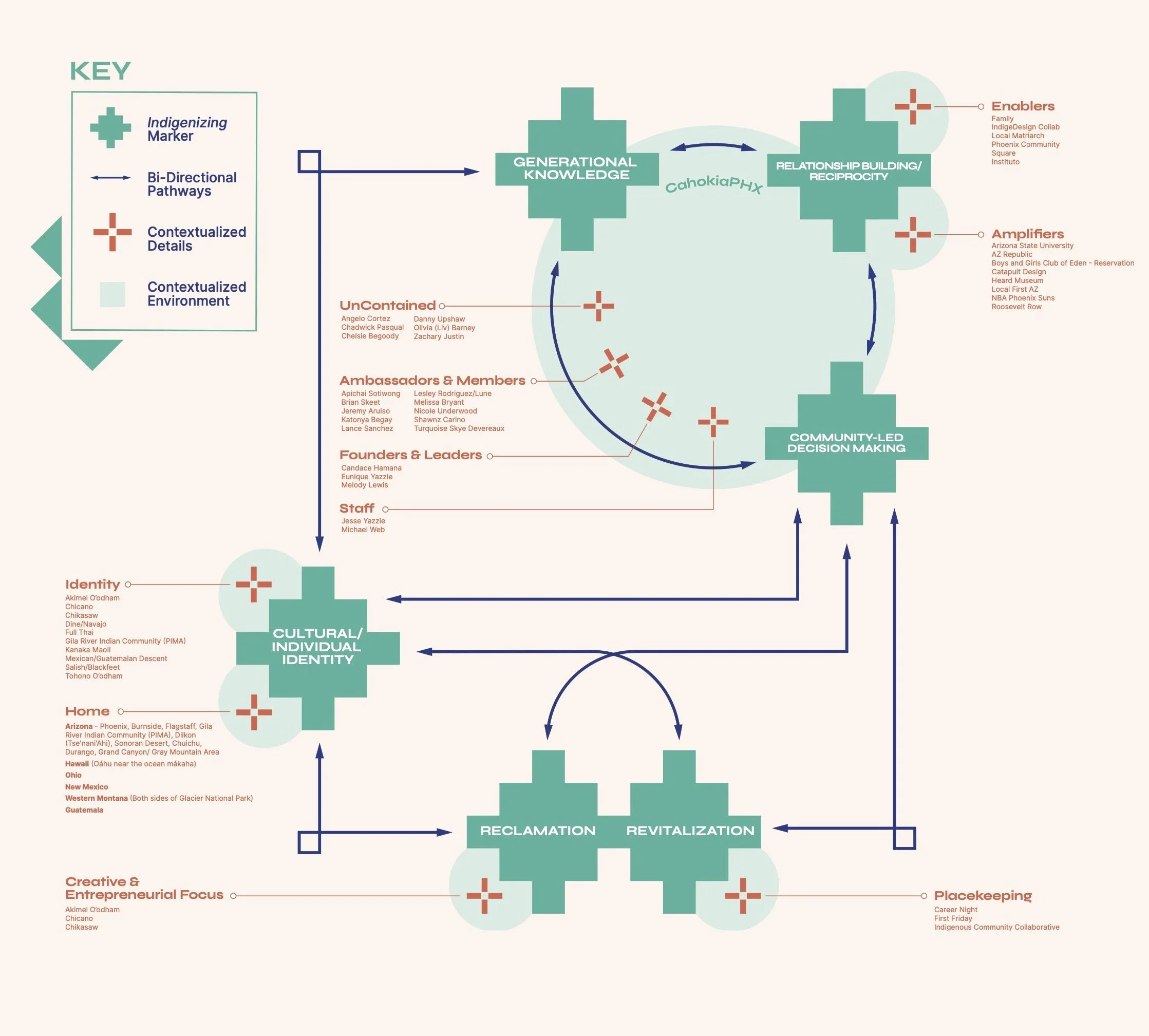
The work produced an Indigenizing Design Framework in three interlocking parts.
Six Indigenizing Markers: Community-Led Decision Making, Generational Knowledge, Revitalization, Reclamation, Cultural/Individual Identity, and Relationship Building/Reciprocity. Each Marker does double duty: a value that defines Indigenizing, and an indicator that tells you whether it has happened. The Markers emerged from consensus in a specific intertribal setting, which makes them contextual by design. Another community running this process would arrive at a different list, and that divergence is the framework working, not failing.
An Ecosystem of Indigenizing: a map of how the Markers relate to one another in a particular place, overlaid with the people, tribal affiliations, homelands, and events that make up the CahokiaPHX ecosystem. Bi-directional pathways, no predetermined starting point. Here, Community-Led Decision Making proved the driver with the most influence on the rest.
An Indigenizing Curriculum: lesson plans and activities that teach the Markers and how to apply them. Written for Indigenous creatives navigating the translation between two worlds, and for non-Indigenous designers who want to collaborate with the cultural understanding the work requires.
The work is ongoing. It has since been funded by the Bhatia Foundation and a second National Endowment for the Arts Design Grant, extending the Framework and Curriculum to new communities and contexts.